We moeten verifiëren dat uw registratie niet om een geautomatiseerde ingave in ons systeem gaat. Vervolledig aub de onderstaande test...
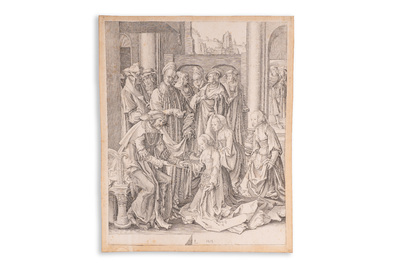
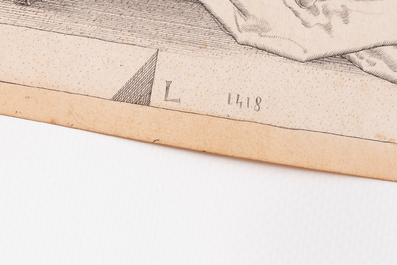
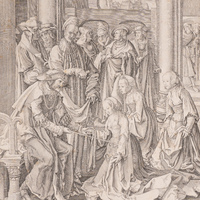
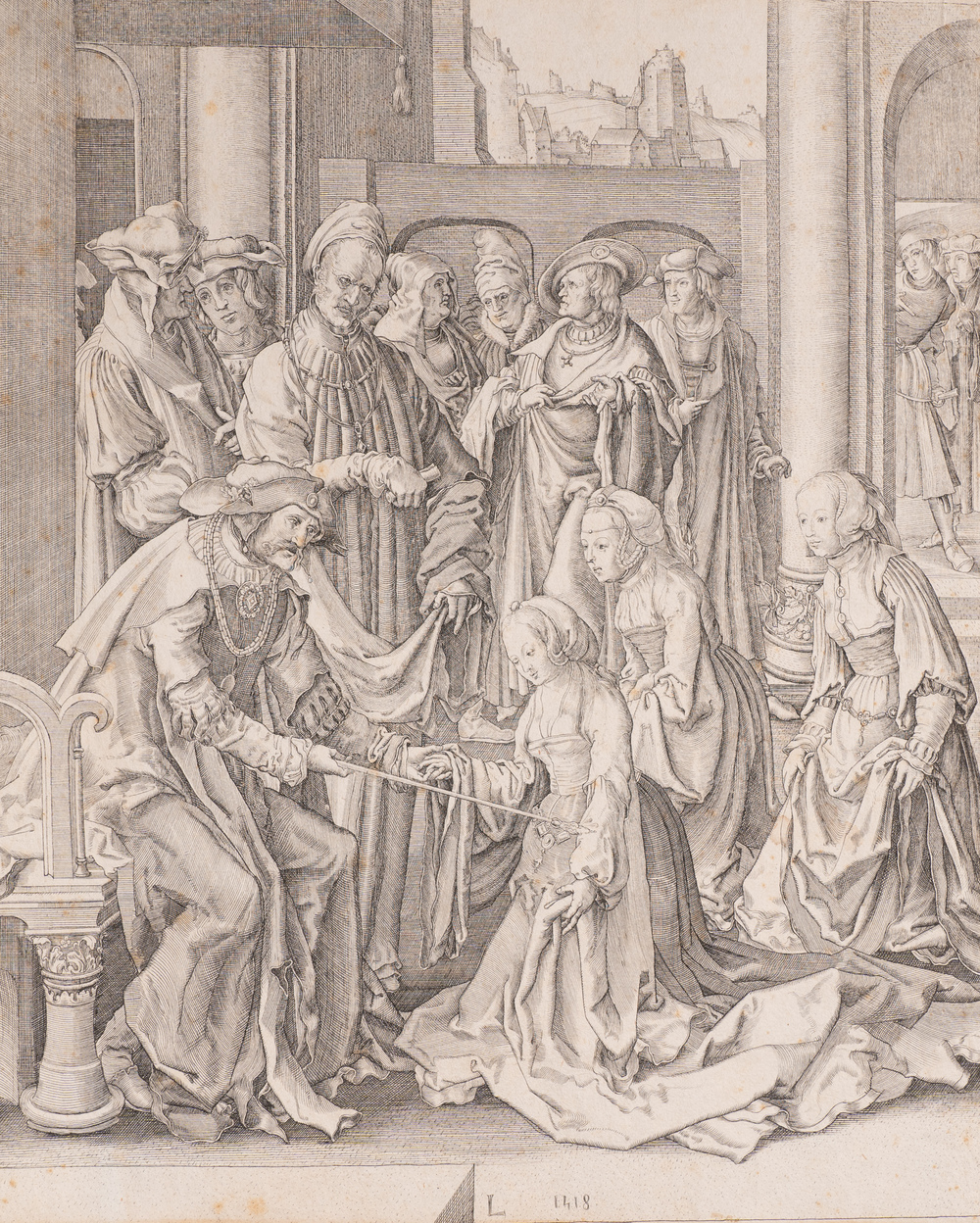
Lucas van Leyden (1494-1533): Esther knielt voor Ahasverus, gravure, 16e eeuw
1070
Dit lot werd verkocht op 2023-12-14 en is niet meer beschikbaar
Dim.: 28,5 x 23,5 cm
In June 1521, in the diary that Albrecht Durer kept of his journey to the Netherlands from July 12, 1520, to July 15, 1521, he wrote that he had met 'Master Lucas ... a little man, born in Leyden in Holland.' On that day he drew Lucas's portrait in metalpoint (now in Lille, Musée des Beaux-Arts), and a few days later the two exchanged prints. This terse account is the only surviving written document of the meeting between the German artist and his younger Netherlandish counterpart, an encounter that brought together two consummate printmakers who were to leave their mark on the development of the medium in Europe for the next century.
Durer was the first to bring together the separate traditions of woodcut and engraving, and his prints in both these media, the product of his apparently inexhaustible imagination, began to attract notice almost as soon as he started making them in the 1490's. Well before the end of the decade, with a print such as 'Samson Rending the Lion', Durer had elevated woodcut to the level of engraving. Lines as lively and free as these, and compositions as dense and complex, had never before been executed in woodcut. By 1500, with his engravings 'The Prodigal Son' and, especially, some esoteric allegorical such as 'The Dream of the Doctor' and 'Hercules at the Crossroads', had established the medium as a bearer of highly sophisticated images and subjects, of meanings. In 1521 Durer was fifty, and he had created most of his more than three hundred prints (indeed, throughout his trip to the Netherlands he stayed ahead of his expenses by selling a number of them). His extraordinary production established the possibility of the print as a medium for artistic ideas in an unprecedented way.
Lucas van Leyden, close to twenty years younger than Durer, was a prodigy who was said to have begun making prints when he was nine years old. He also was famous by 1521, and his engravings, such as the poignant 'Saint Paul Led away to Damascus', were admired both for their unusual or unexpectedly treated subjects and for their refined, delicate style. Both artists' innovations had a striking influence on Renaissance printmaking and on subsequent developments of the medium.
Remarkably,their creative inventions were built on techniques for suggesting form and tone in a purely black-and-white medium that had only recently been invented and honed by Gothic artists such as Master ES and Martin Schongauer, who had guided the print from its roots as a comparatively coarse craft and workshop by-product to a refined and noble art. At the time of Lucas's and Durer's meeting, printmaking had only a fifty-year history as a medium capable of producing the type of sophisticated artwork that these two men created. (source: Suzanne Boorsch/Nadine M. Oorenstein, The Print in the North, The Metropolitan Museum of Art Bulletin, Spring 1997 (link)
Geschat:
€ 600
-
€ 1200