
Nous devons vérifier que votre inscription n'est pas une entrée automatique. Veuillez s'il vous plaît compléter le test suivant:
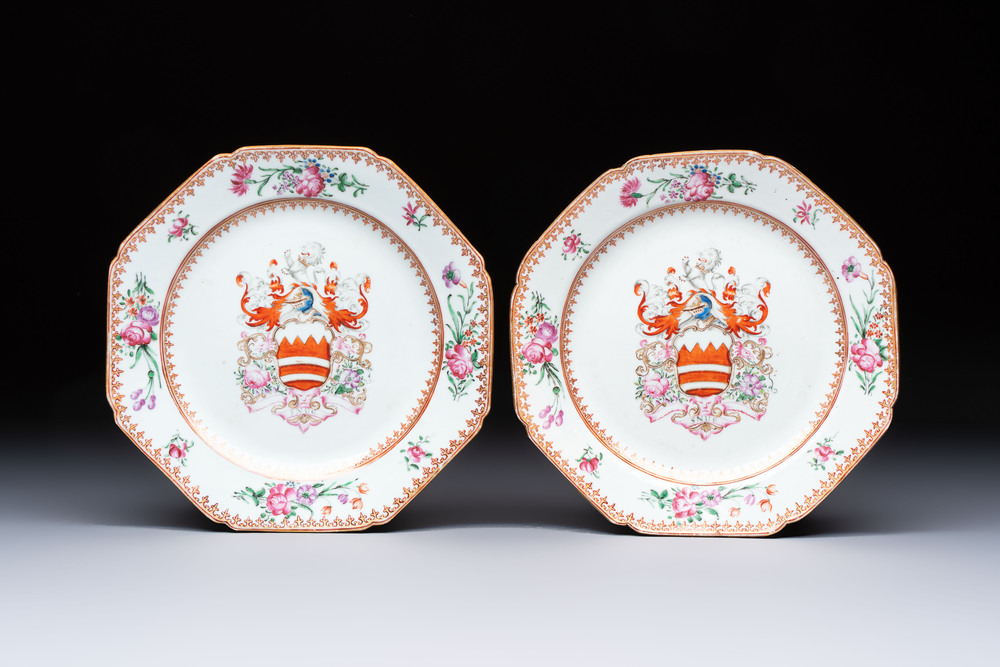
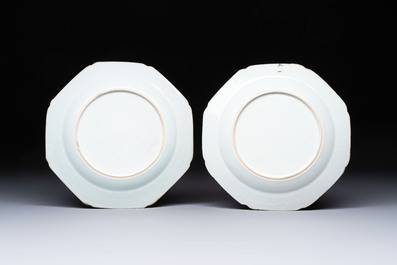
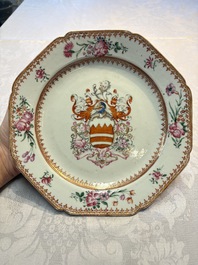
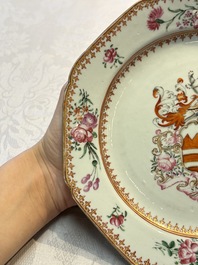
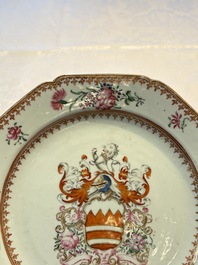
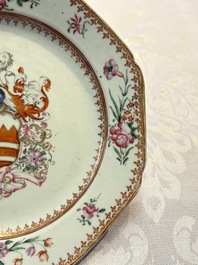
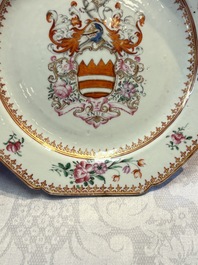
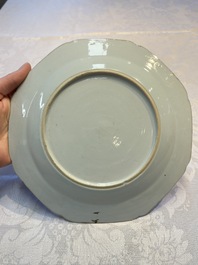
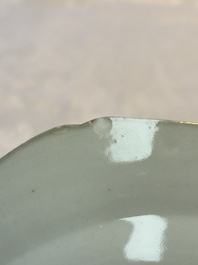
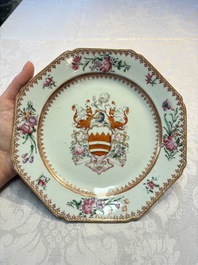
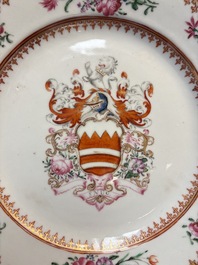
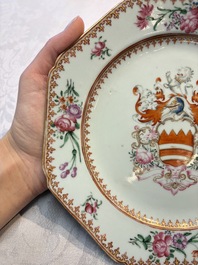
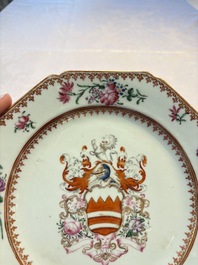
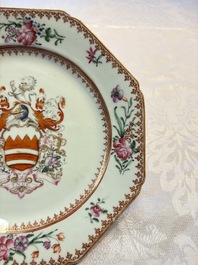
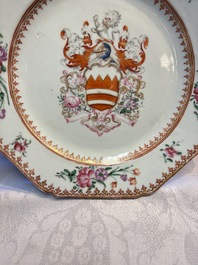
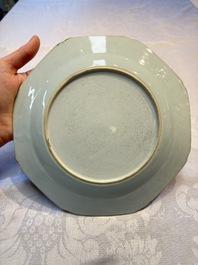
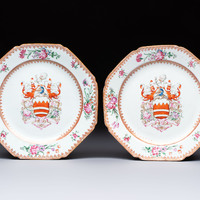
A pair of Chinese famille rose armorial plates with the arms of Hare for the English market, Qianlong, ca. 1755
314
Ce lot a été vendu le 2025-12-16 et n'est plus disponible
Dia.: 23 cm
Ref.:
- For the arms and an identical example, see D.S. Howard, 'Chinese Armorial Porcelain, Vol. I', p. 450.
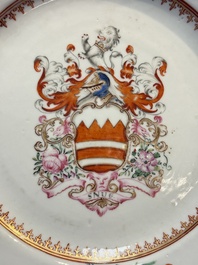
The arms are those of Hare, usually blazoned: Gules, two bars or, and a chief indented of the last (though in this example, the chief is argent). Crest: A demi-lion rampant argent, ducally gorged or. The motto “Snug” is not otherwise recorded.
The family of Hare descends from Sir Nicholas Hare, who was twice Speaker of the House of Commons in the reign of Queen Elizabeth I, and who purchased the estate of Stow Bardolph in Norfolk. Sir Ralph Hare of Stow Bardolph was created a baronet in 1641. His only son left three sons, who succeeded successively as the 3rd, 4th, and 5th Baronets. Sir Ralph, 3rd Baronet, died in 1732; his brother Sir Thomas died without issue in 1760; and the third brother, Sir George, a Major in the Dragoons, died unmarried in 1764, at which point the title became extinct. The present Hare baronets descend from his sister’s grandson.
The Hare family of Ireland, later Earls of Listowel, bears exactly the same arms as the Norfolk baronets. Richard Hare had two sons: the younger, John, died in 1774; the elder, William, Member of Parliament for Cork and Athney, was created Baron Ennismore in 1800 and elevated to the Earldom of Listowel in 1816.
The Hare family of Suffolk is also recorded with this coat (with the chief argent), but with the crest: A lion rampant argent. A Francis Hare is noted as a member of the Council in Bengal in 1760. (Source: D.S. Howard, 'Chinese Armorial Porcelain, Vol. I'.