Nous devons vérifier que votre inscription n'est pas une entrée automatique. Veuillez s'il vous plaît compléter le test suivant:
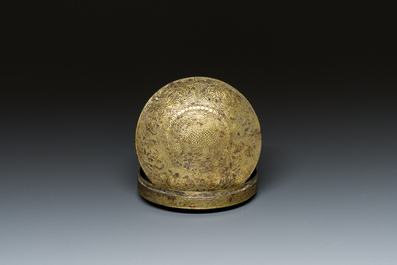
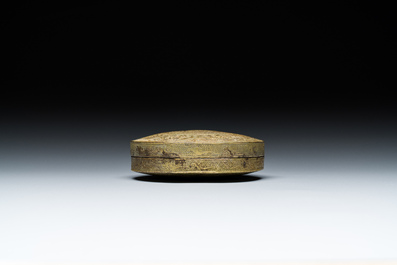
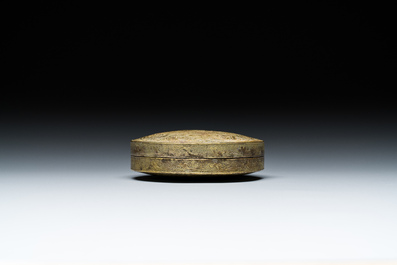
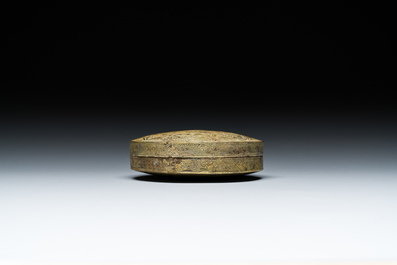
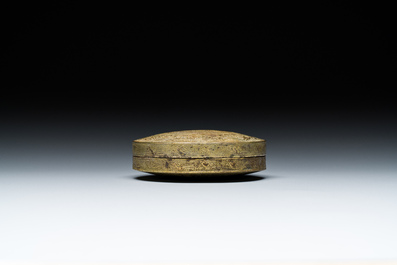
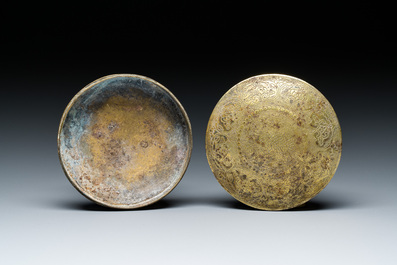
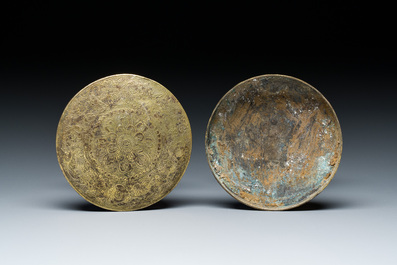
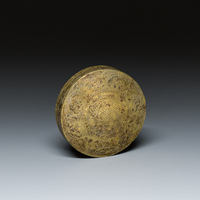
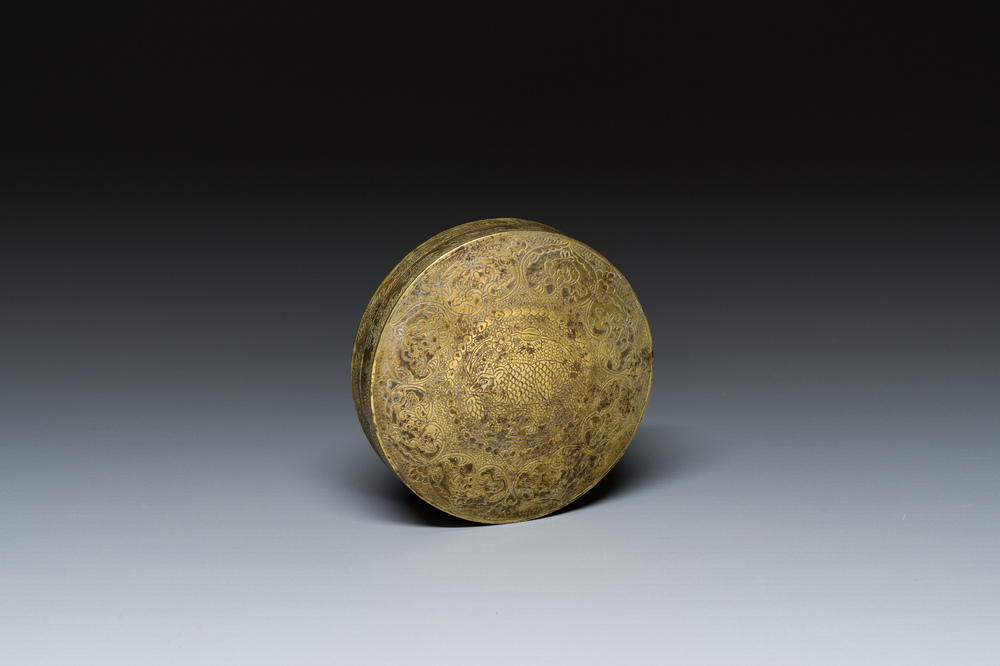
Boîte couverte en alliage de cuivre doré à décor d'un rhinocéros, Chine, Tang
813
Ce lot a été vendu le 2023-12-14 et n'est plus disponible
Dia.: 7,5 cm - H.: 2,5 cm
Provenance: An old Belgian private collection.
Ref.: Sotheby's, New York, Sep. 21, 2022, lot 330, for a similar example. (link)
In the Shang and early Zhou periods the rhinoceros was prized for its tough hide, which was used to make armour. By the Warring States period, if not earlier, belief had taken hold that the beast’s horn could detect, even neutralize, poison in food and drink, giving the rhinoceros special cachet. In fashioning armor, the hide - whether rhinoceros hide or leather from the hide of an ox or other animal - once dried and properly prepared, was cut into small rectangular strips, known as plates, that were linked together to form lamellar armor, often termed fish-scale armor in Chinese. Such armor no doubt resembled the lamellar armor worn by the terracotta warriors recovered from the trenches around the tomb of Qinshihuangdi (r. 221 - 210 BC), though the lamellar armor of Qinshihuang’s warriors surely had plates of leather or, more likely, of iron. With the gradual extinction of the rhinoceros in north China late in the Bronze Age (c. 1700 BC - AD 220) and with the rise of iron-plate armor during the Zhou, the use of rhinoceros-hide armor had seriously declined by the early years of our era; even so, it is believed that at least a little rhino-hide armor was still being made during the Tang dynasty. And a diagram in a book published in 1852 indicates that rhinoceros-hide armor was still in use for ceremonial purposes as late as the Qing dynasty.
Without written records from the Tang clearly stating the reason, we cannot know why the rhinoceros is depicted with scales. Apart from mere artistic license, the most plausible explanation for so portraying the rhinoceros is that the beast had become conflated with the qilin in the thinking of the day. Indeed, some individuals believed the rhinoceros to be the qilin, a mythical hooved chimerical creature from Chinese mythology. (In the Ming dynasty the giraffe was believed by many to be the qilin.) Although often depicted with the lithe body and furred hide of a deer, the qilin is also frequently shown with scales over its body, as witnessed by the Yuan-dynasty (1279 - 1368), blue-and-white charger with qilin decor in the Rijksmuseum, Amsterdam (AK-RBK-1965-88).
Estimation:
€ 600
-
€ 1200