We have to double-check your registration and make sure this is not an automated entry in our system. Please complete the test below...
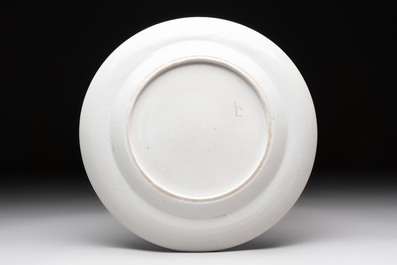
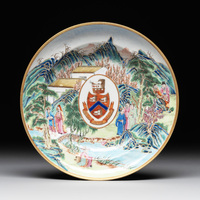
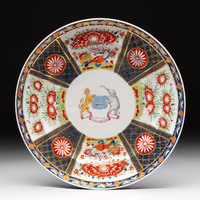
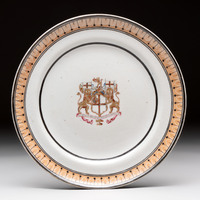
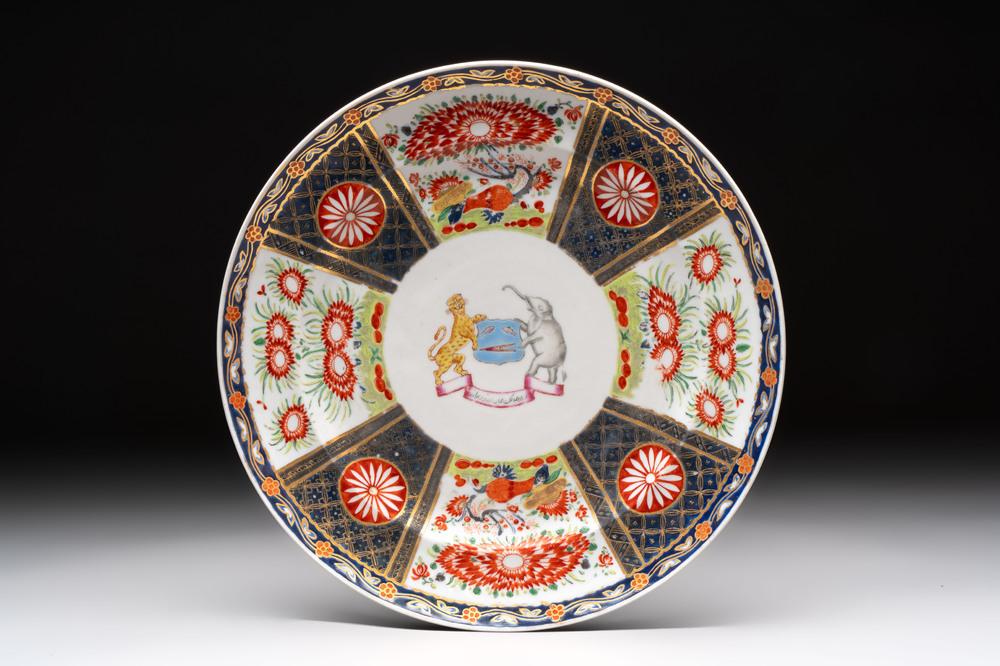
A Chinese rose-Imari armorial dish with the arms of Bahadur II for the Indian market, Jiaqing, ca. 1820
865
This lot was sold on 2025-06-19 and is no longer available
Dia.: 25 cm
The coat of arms are of Muhammad Bahadur II Shah (1775-1862), the last emperor of the Mughal dynasty (1526-1862) in India. As a pensioner of the Honourable East India Company, he held little real power and was largely confined to the Red Fort in Delhi. Despite this, his court remained a vibrant centre of Urdu culture. During the Indian Rebellion of 1857, he reluctantly became the symbolic leader of the uprising. After the British recaptured Delhi, he was arrested, tried for treason, and exiled to Rangoon (now Yangon), where he died in 1862. The inscription below the coat of arms reads 'The ministers and nobles are a God-given (creation of) ‘Be, and it is’.
The design of this service is copied from a design used by the Worcester porcelain factory from about 1762 to 1805. According to Ayers, it is copied exactly after a service made for Hay, Earl of Errol in the late 1790. A similar service for the Dutch market has the arms of Constantijn Johan Wolterbeek, governer of Malaca from 1818 to 1820, and was gifted to him by the Sultan of Malaca in 1818. (Source: H. Ayers, 'China for the West', p. 487, J. Kroes, 'Chinese armorial porcelain for the Dutch market' no. 443)
Ref.:
- The Metropolitan Museum, New York, object Number: 51.86.363, for hot-water plate from this service. (link)
- D.S. Howard, 'Chinese Armorial Porcelain', Vol. II, p. 695, for a nearly identical plate.
Lot note:
Interestingly, the coat of arms from this particular service has been copied by the workshops of the Vietnamese imperial court in the first half of the 19th Century. Emperor Minh Mang (ruled 1820-1841) had a taste for export arts and acquired many items from the West for the Hue royal palace. There are just a few copper-enamel candlesticks known with these coat of arms, directly copied from this service, and slightly altered to suit the king's taste. One is in the Hue Museum of Royal Antiquities, inventory number BTH/861/ĐG-12, and a pair was sold by Lynda Trouvé in 2024 (link). (note by Mr. L. Loose)